Trills! Today i’m going to go over the types of trills a pianist will encounter in their music! Next week I will go over ways to practice these, for a quick and beautiful sound.
Appogiatura
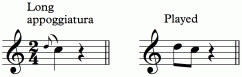
Appogiatura’s are written as a small eighth note, slurred to a longer (normal sized) note. Despite it being written to look like two different time values, the pianist actually plays them as two eighth notes! Confusing, I know.
Acciaccatura
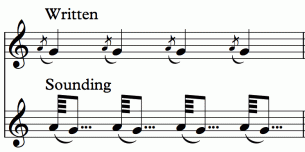
Also called ‘grace notes’, these notes are played VERY quickly, moving immediately into the note it is slurred to. Fun!
Upper Mordent
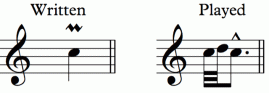
Time for the squiggly lines! If you look closely, you can see the squiggly line starts low, and moves up. This is your hint as to where the trill starts, and where it moves to! With an upper mordent, you start on the given note, move to the note immediately above, and then return to the given note, in quick succession.
Lower Mordent
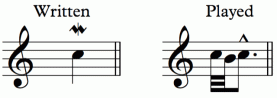
Watch out for the tiny line in the middle of this trill – it means to start on the given note, move to the note immediately BELOW, and then return to the given note, again in quick succession.
Turn
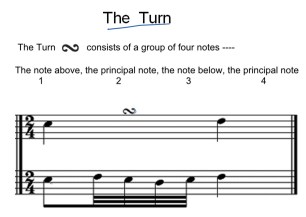
As you can see, the turn roughly follows the shape of its symbol (a sideways S); It starts on the given note, steps up, returns to given note, steps down, and then returns up to the given note.
Trill
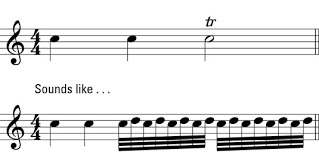
I saved the best for last! This is the ornament that likes to show off. With a trill, you start on the given note, and alternate rapidly between it and the note directly above, for the length of the given note. As you can see in the example, that fits in a lot of notes!
 Crawford Music Studio